
This program is subject to the competitive admission process.
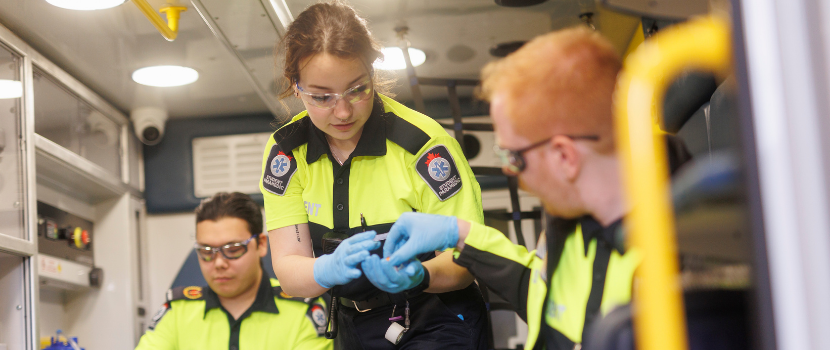
Being a paramedic is all about teamwork. There’s a sense of camaraderie you won’t find in many other jobs. But it takes a special kind of person. You have to want to help people because you’ll be attending to people of all ages in all kinds of crises. You have to work well under pressure because you’ll be delivering pre-hospital emergency care in people’s homes, in the middle of busy streets, and/or at industrial sites.
Start date
September
Length
81 weeks
Location(s)
Regina, SaskatoonIt’s a rewarding career with an expanding range of job opportunities—and Saskatchewan Polytechnic’s Primary Care Paramedic program will get you started.
Primary Care Paramedic is a two-year diploma program offered through Saskatchewan Polytechnic Saskatoon campus and Saskatchewan Polytechnic Regina campus, and in partnership with regional colleges. Our program emphasizes authentic hands-on training in prehospital emergency care, with both hospital and ambulance practicums. You’ll focus on:
- medical and trauma injuries
- mental health issues
- obstetrical emergencies
- pharmacology
- physical assessments of various body systems
- cardiac and respiratory emergencies
- certifications in:
- BLS Health Care Provider
- Gentle Persuasive Approach (GPA)
- International Trauma Life Support (ITLS)
- Pediatric Education for Prehospital Professionals (PEPP)

Hands-on learning
- Lab and simulation training
- The program emphasizes hands-on learning. You’ll spend about one-third of your time in the classroom, one-third in practical labs and one-third in high-fidelity simulation. State-of-the-art simulation facilities use a wide range of scenarios to help you develop your critical thinking and decision-making skills.
- Field practicums
- You’ll take the knowledge that you’ve learned in the classroom and put it to work with an emergency medical services (EMS) organization (usually ambulance service) to learn about policies, procedures and documentation; conduct independent patient assessments; and provide treatment using ambulance equipment.
- Clinical practicums
- During your hospital-based practicum, you’ll conduct independent patient assessments and use hospital equipment to provide treatment. You’ll also learn about hospital policies, procedures and documentation.
- Inter-professional education
- In order to prepare you for an integrated role within health care teams, you will have the opportunity to work with students from other programs within the School of Health Sciences and the School of Nursing. Learning activities are designed using a problem-based learning model and include high-fidelity simulations, interactive case-based table-top exercises, and collaborative skill acquisition.
Serve in the Canadian Armed Forces
Career and salary information
Your career
As a primary care paramedic, you’ll find your skills in demand by ambulance, air ambulance and fire protection services around the province. You’ll also find job opportunities in the military, at mine sites, and at industrial manufacturing, milling and processing sites.
For more information about career opportunities, contact Student Employment Services at the Saskatchewan Polytechnic campus nearest you or check out the Saskatchewan College of Paramedics job postings.
Potential careers
| Sample job title | NOC classification |
|---|---|
| Safety officer | Occupational health & safety specialists (22232) |
| Emergency medical technician (EMT) | Paramedical occupations (32102) |
|
Firefighter* |
Firefighters (42101) |
*Fire Services often require Primary Care Paramedic for employment and may provide firefighter training for qualified primary care paramedics.
Admissions
Admission requirements
- Grade 12 with a minimum overall average of 65%, or equivalent, in the following courses: one 30-level English Language Arts, Biology 30, one of Workplace and Apprenticeship Math 30 or Foundations of Math 30 or Pre-Calculus 30 (Previous Saskatchewan Math A30 will also be accepted), and one additional 30 level Natural Science or Social Science or Humanities.
- See English Language Proficiency Requirements for required evidence for this program (Program-Specific ELP Requirements section).
- Applicants must be 18 years old by the start of the program.
Note
- Health Science 20 and Chemistry 30 are not admission requirements; however, they may enhance a student's ability to succeed in the program.
- Accepted applicants will be required to provide a Criminal Record Check and Vulnerable Sector Search prior to the start date of the program. At the discretion of the practicum/clinical agency, access to a clinical or work practicum agency may be declined based on the contents of the Criminal Record Check and Vulnerable Sector Search. As the program requirements cannot be met without placement, admission to the program will be revoked if placement is declined and the applicant may reapply once the record has been cleared. The cost of the Criminal Record Check and Vulnerable Sector Search is the applicant's responsibility. Renewal throughout the program will be required.
- Accepted applicants must exhibit physical strength and fitness consistent with the requirements of professional practice to complete the program.
- Standard First Aid is required and must be current at the start of the program.
- Heart and Stroke Basic Life Support (BLS) is required and must be current at the start of the program.
- Current Transferring Lifting Repositioning (TLR®) certification OR Transferring Lifting Repositioning (TLR®) Emergency Medical Services (EMS) certification is required upon admission into the program. The cost of (TLR®) certification or Transferring Lifting Repositioning (TLR®) Emergency Medical Services (EMS) certification is the applicant's responsibility. This is required prior to the start of Semester 1.
- Accepted applicants are required to provide current immunization records that meet Saskatchewan Polytechnic immunization requirements prior to the start date of Semester 1.
- Current N95 respirator mask testing is required prior to the start date of the first clinical/practicum. The cost of N95 respirator mask testing is the applicant's responsibility.
- Accepted applicants are required to provide evidence of current WHMIS Globally Harmonized System (GHS) certification prior to the first practicum placement. Recertification will be required every three years to remain current. The cost of WHMIS certification is the applicant's responsibility.
Admission method
Competitive
The competitive admissions process is used for programs where the number of qualified applicants regularly exceeds the number of spaces available. In competitive programs, higher admission requirements and/or additional selection criteria may be required.
Applications open October 1, each academic year.
Domestic student deadlines:
- Application deadline: February 15, each academic year
- Document submission deadline: March 1, each academic year
International student deadlines:
- Application deadline: December 31, each academic year
- Document submission deadline: January 31, each academic year
All supporting documentation is required by 4:30 p.m. (CST) on the document deadline date. When document deadline falls on a weekend, documents are due the following Monday.
See Admission Processes for more information about this method of admission.
Selection criteria
Applications are ranked in the order of highest averages.
- Category A: High school applicants (current high school students, high school graduates
and
applicants with less than 15 credit units from a recognized post-secondary institution). - Category B: Post-secondary applicants (students with a minimum of 15 credit units
from a
recognized post-secondary institution).
Admission average calculation for current high school students
The admission average calculation for current high school students is based on final marks provided by the posted date. High school students must order transcripts to be sent directly to Sask Polytech at the end of Semester 1 and the end of Semester 2 of the grade 12 year. Students who have not yet graduated from grade 12, and who are registered in the Adult 12 program with Sask Polytech, must have their instructor submit, in writing, the relevant mid-term mark(s) by the posted date. These mid-term marks will be used in the admission average calculation. For the admission average calculation, the final grade 12 mark is used if the course is completed, and the final grade 11 mark is used only in the absence of the grade 12 mark in the same subject. Sask Polytech does not use projected or predicted marks in the absence of final marks. All program-specific admission requirements must be met before final admission is granted.
Applications are ranked in the order of highest averages.
Admission average calculation for high school graduates
The admission average calculation for high school graduates is based on the final marks in high-school courses required for admission to the specific program. Approved post-secondary equivalents may meet specific course requirements, but Saskatchewan Polytechnic uses the post secondary equivalent only in the absence of high school marks when calculating the average. High school graduates must provide final marks obtained through upgrading, along with all post-secondary transcripts, by the posted deadline.
Applications are ranked in the order of highest averages.
Applicants with 15 or more credits should refer to Admissions average calculation for post-secondary students.
Post-secondary students
Applicants must meet requirements for the specific program to which they apply. Approved post-secondary equivalents may meet specific course requirements. Saskatchewan Polytechnic bases the admissions average calculation on post-secondary courses from recognized institutions (minimum 15 credits to a maximum of 30 recent credits), requires a minimum 60% average, and confirms good standing. Saskatchewan Polytechnic ranks applications in the order of highest averages. Applicants must provide all post-secondary transcripts by the posted deadline. Saskatchewan Polytechnic uses only final grades provided by the posted deadline. All competitive programs include an assessment in which a competitive score is calculated, and applicants are ranked based on academic performance.
Tuition and fees
Estimates are based on current rates and are subject to change. Amounts for a program may vary by campus. Totals shown here include all mandatory fees as well as approximate cost for books and supplies. Visit the Tuition and Fees web page for a complete breakdown of tuition and fees for this program.
2027-28 academic year
To be determined.
Courses
Get credit for what you know
Prior Learning Assessment and Recognition
Saskatchewan Polytechnic recognizes that adults learn in many different ways. This includes acquiring knowledge and skills through life and work experience or non-formal training.
See link(s) below to get more information about PLAR.
Transfer credit
Many Sask Polytech students benefit from transferring course credit. You may be eligible to transfer credit to Sask Polytech or to another college or university.
Student awards
Thanks to the generosity of donors and alumni, Saskatchewan Polytechnic gives away more than $2 million in student awards during the academic year.
Saskatchewan Polytechnic offers student awards for every certificate and diploma program at every campus. Not all student awards are based on marks - some are based on financial need or things like community or volunteer involvement.
Accreditation
Accreditation Canada / EQual Canada
Saskatchewan Polytechnic's Primary Care Paramedic program is fully accredited by Accreditation Canada/EQual Canada. This qualifies you to write the national Canadian Organization of Paramedic Regulators (COPR) entry to practice exam. With examination success, you'll be eligible for licensure by the Saskatchewan College of Paramedics and other Provincial Regulators across Canada.
The cost of the COPR national certification exam is the responsibility of the student.
Related programs
Additional information
If you have any questions, please email paramedicprogramsrecruitment@saskpolytech.ca
