
For many entrepreneurs, a promising idea is only the beginning. Transforming a concept into a viable product or business requires technical expertise, market validation and the right support network. Through the national Labs4 program, hosted at Saskatchewan Polytechnic, alumni Nicholas Duggan and Mousumi Dhar, and research assistant Ethan Bowes found opportunities to move their projects beyond the idea stage while gaining valuable experience in innovation and entrepreneurship. They also each received $10,000 to help them work on their business!
Duggan, a 2025 alumni of the Design and Manufacturing Engineering Technology (DMET) program, spent months developing an ergonomic snow shovel designed to reduce strain during snow removal. The project began when he took on the concept on behalf of a client while working with Sask Polytech’s Research in Additive Manufacturing and Prototyping (RAMP) team as a student researcher.

Drawing on the engineering and manufacturing skills he developed through DMET, Duggan created and refined a shovel featuring an adjustable second handle, a spring-loaded shovel head and composite materials intended to improve ergonomics while maintaining durability in harsh Canadian winter conditions. While working on the project, his supervisor recommended applying to the Labs4 program.
"DMET gave me the skills I needed to design and manufacture the shovel and make sure it was strong enough," said Duggan. "Labs4 gave me the opportunity to learn more about entrepreneurship, product commercialization and business development."
The experience closely reflected the work Duggan now performs as a research technologist with RAMP, where clients bring technical challenges requiring prototypes, proof-of-concept development or product validation.

"What I do with RAMP is very similar to the work I did on the shovel project," he said. "Clients come with an idea that doesn't have a readily available answer and we help develop it."
Duggan believes the experience demonstrates how applied research can help innovators move early-stage ideas toward commercialization.
Anu Tandukar, manager of Labs4 at Sask Polytech, notes that every participant to date has created a working prototype, demonstrating how the program helps innovators move their ideas closer to market. “Labs4 provides mentorship, ongoing product development support, and funding for materials and supplies to help participants build, test and validate their solutions.”
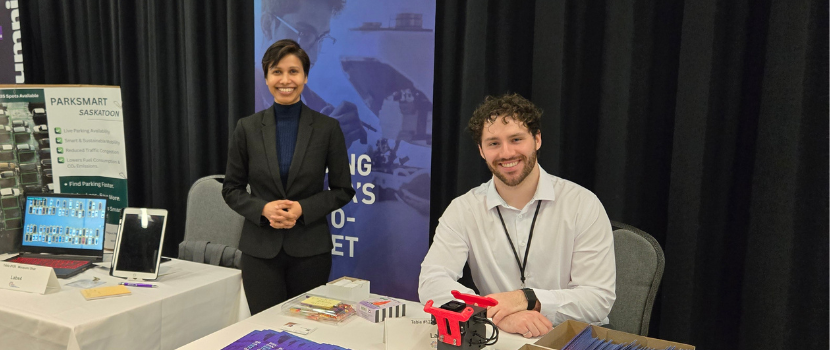
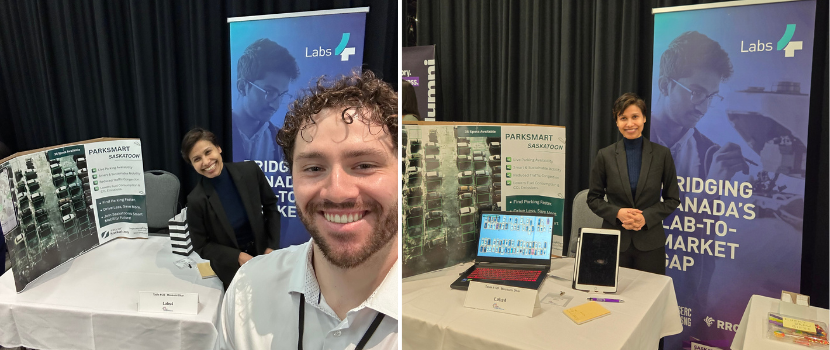
For Cloud Computing and Blockchain and Information Technology Project Management alumna Dhar, Labs4 provided a pathway to explore an entirely different challenge: parking management.
Dhar's project, ParkSmart Saskatoon, uses artificial intelligence and video analytics to identify parking stall occupancy in real time. The concept aims to help drivers locate available parking spaces before arriving while providing operators with data on occupancy, demand and usage patterns.
The idea originated as a capstone project. "What began as a class project quickly grew into something much larger," said Dhar. "The support and opportunities I received at Sask Polytech helped me see the potential beyond academics."
After presenting ParkSmart at Sask Polytech's Applied Research Student Showcase and winning the People's Choice Award, Dhar gained confidence to pursue the concept further. A major milestone came after graduation when the City of Saskatoon provided 48 hours of parking video footage for testing and validation.
Through Labs4, Dhar shifted her focus from the technical aspects of the platform to the realities of launching a business. The program connected her with mentors, experts and potential customers while helping advance the project's technical readiness. Dhar conducted more than 40 customer discovery interviews with municipal representatives, parking operators and industry professionals.
"The feedback wasn't always positive but it helped me understand what may and may not work in the market," she said.
Those conversations also revealed important challenges. One key lesson was that relying exclusively on cameras may limit scalability because camera infrastructure is not available in every location. As a result, Dhar is now exploring potential pivots while continuing customer research.
Today, ParkSmart has a working prototype tested using real-world footage and a much clearer understanding of market requirements. Dhar credits Labs4 with helping her build both technical and entrepreneurial confidence.
"The most valuable part was learning how to speak with potential customers and validate an idea," she said.
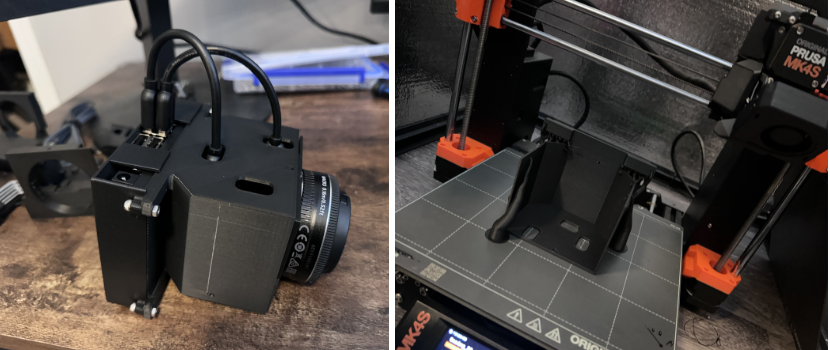
Bowes is a university graduate currently working for Sustainability-Led Integrated Centres of Excellence (SLICE) at Sask Polytech. His project focuses on developing a multispectral imaging system to detect Fusarium Head Blight in cereal crops. Fusarium is a fungal disease that produces toxins harmful to people and animals and causes more than $1 billion in losses to Canadian farmers each year. To address this challenge, Bowes designed a five-band camera that combines color and near-infrared imaging and can be mounted on a drone. The system creates digital maps showing disease distribution across fields, helping growers and agronomists make informed harvest decisions, reduce contamination risks and preserve crop value.
“Labs4 pushed the project forward on both the technical and business fronts,” says Bowes. “With the program’s support, I transformed a cumbersome prototype into a more practical, field-ready camera. Labs4 also emphasized the importance of market validation, encouraging me to conduct industry interviews and engage directly with potential customers. Those conversations ultimately turned this applied research project into a viable commercial opportunity.”
For this project Bowes accessed SLICE facilities, expertise and mentorship. Through mentorship from Dr. Abdul Raouf, SLICE research chair, Bowes learned about geospatial science and GIS mapping. This experience shaped the project’s core vision: creating actionable maps that support agricultural decision-making rather than simply collecting data.
Currently, efforts are focused on refining the software that converts raw imagery into accurate disease classifications. Next steps include completing the classification pipeline, conducting drone-based field testing, validating results at larger scales and launching pilot projects with potential customers.
“The most valuable aspect of Labs4 was the mentorship, encouraging a researcher-to-entrepreneur mindset and reinforcing the importance of understanding customer needs early in the innovation process,” says Bowes.
For Duggan, Dhar and Bowes, the Labs4 experience highlights the role Sask Polytech plays in helping innovators bridge the gap between education, applied research and entrepreneurship. Whether developing a new snow shovel, exploring smarter urban mobility solutions or detecting fungal disease in crops, Labs4 provided a foundation for turning ideas into opportunities.
Do you have a business idea you need support with? Sask Polytech continues to offer Labs4 training and support. Learn more about how Sask Polytech supports entrepreneurs through the Business Innovation and Entrepreneurship Centre.
