
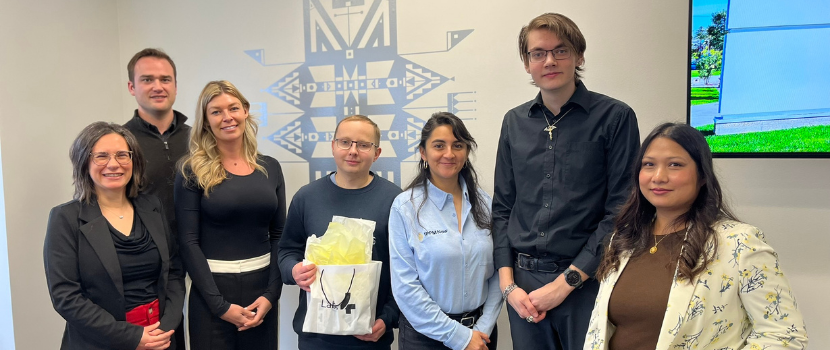
Dylan Haussecker stood before three Saskatchewan Polytechnic judges, explaining how his app, TAUlab, could save contractors weeks of work with a simple sensor. Behind him, two other Saskatchewan innovators waited their turn, each hoping their idea would stand out.
This was the final pitch session for Labs4’s inaugural Technology Readiness Level (TRL) Saskatchewan cohort, part of a Canada-wide initiative to bridge the gap between applied research and commercialization.
More than 60 participants from across the country were accepted into the TRL program, which was offered virtually to foster collaboration from coast to coast. Locally, the three Saskatchewan entrepreneurs worked with Sask Polytech advisors Dr. Terry Peckham, director and research chair at the Digital Integration Centre of Excellence (DICE), and Leon Lipoth research chair at the Research in Additive Manufacturing and Prototyping (RAMP) facility.
Over four months, participants received a $10,000 stipend, worked with their Sask Polytech advisors, completed weekly development sprints and participated in customized business training virtually. The TRL curriculum focused on business models, commercialization strategies and customer evaluation methods, important business tools designed to help innovators align their research with real-world demand.
Sask Polytech judges from the Office of Applied Research and Innovation, the Centre for Continuing Education and School of Business and Entrepreneurship listened to each entrepreneur’s five-minute pitch, followed by a question-and-answer session. After deliberation, Dylan Haussecker was named the winner and received a gift bag along with a $250 gift card.
“Congratulations to the first Labs4 Saskatchewan TRL cohort on reaching this milestone,” says Dr. Larry Rosia, Sask Polytech president and CEO. “Your creativity, perseverance and commitment to turning ideas into real-world solutions are inspiring. We’re extremely proud to support innovators like you as you take the next steps toward commercialization and launching your businesses.”
“Labs4 is an excellent initiative that highlights the unique ability of polytechnics to bridge innovation and industry,” says Ian McWilliams, associate vice-president, Applied Research and Continuing Education. “At Sask Polytech, we’re contributing our strengths in applied research and training to the Labs4 program. Through business learning modules and internships at our applied research centres, we’ll offer innovators valuable training and mentorship to help them transition into entrepreneurship.”
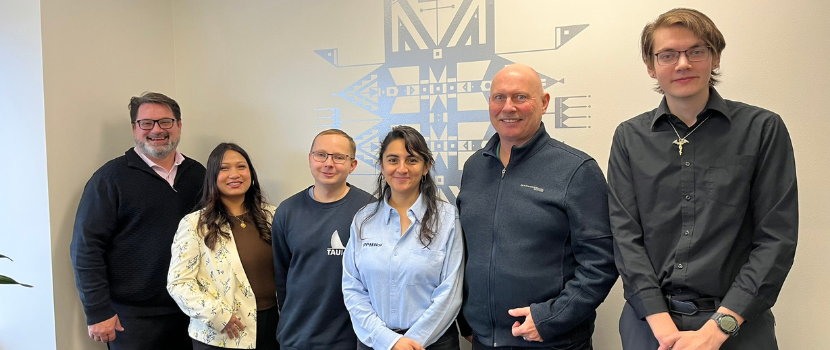
Haussecker, founder of TAUlab, impressed judges with a platform that helps small and mid-sized contractors turn equipment and jobsite data into actionable insights. A wireless tag installed on equipment automatically tracks location and engine hours, syncing with a dashboard that organizes data, generates reports and schedules maintenance. TAUlab’s devices aim to save contractors up to 20 days on an average job. The Saskatoon-based startup has already secured paying customers and plans to expand across Western Canada in the future. Haussecker received advice from Peckham.
Other participants showcased equally innovative ideas. Nicholas Duggan, a Sask Polytech Design and Manufacturing Engineering Technology graduate, introduced ErgoShift, an ergonomic shovel designed to reduce strain during snow removal. Built with composite materials and featuring an adjustable second handle and spring-loaded head, the shovel targets Canada’s winter market. Duggan plans to launch online sales in late 2026 and eventually patent the design. Duggan worked in Sask Polytech’s RAMP facility, receiving guidance from his advisor Lipoth.
Teresa Aguiar-Cordero introduced IPPM Now, an AI-driven app that helps farmers and agronomists identify insects in prairie crops. The tool delivers pest management recommendations in seconds, aiming to reduce unnecessary pesticide use and improve sustainability. Early prototypes have achieved 94 per cent accuracy in field tests. Aguiar-Cordero hopes to expand the platform to include smart traps that capture and count insects on a larger scale. Aguiar-Cordero Sask Polytech advisor was Peckham.
Labs4 connects 38 colleges, polytechnics and universities through 11 regional and Indigenous entrepreneurship hubs. Funded by NSERC, Mitacs and post-secondary partners, the $55-million initiative is designed to accelerate the journey from idea to market, reduce barriers for equity-seeking groups and strengthen Indigenous and regional innovation.
Saskatchewan Labs4 partners include: Cultivator powered by Conexus, Innovation Saskatchewan, Saskatchewan Indian Institute of Technologies (SIIT), Saskatchewan Polytechnic, University of Regina, and University of Saskatchewan. Sask Polytech serves as the regional hub lead, and SIIT leads pawâcikêwikamik, the Indigenous entrepreneurship hub.
To learn more about Labs4, its programs or upcoming events visit www.labs4.ca.
