

One of the key features of a polytechnic education is hands-on training from people who know the skills they teach from real-world experience. This applies to Saskatchewan Polytechnic faculty—but can also be true of the non-academic staff who support instructors and their students.
Graphic design analyst Joshua Jacobson is a great example of bringing what he knows and practices from experiences outside his day job to his work at Sask Polytech. In his Learning Technologies role within the Division of Learning and Teaching, Jacobson helps train the trainer and boost learning opportunities through tools and platforms that help enrich students’ education.
Jacobson’s skills as a mural artist, graphic designer and extended reality (XR) creator give him a unique perspective on how technology can be used to enhance classroom learning. He has more than two decades of professional practice with more than 60 public and private commissions ranging from municipal murals to organizational brand packages to food-court mall art.
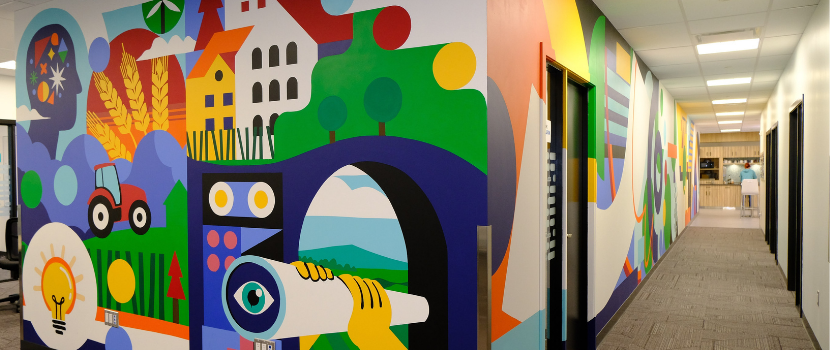
Jacobson has become a leading voice in the intersection of environmental graphics, storytelling and emerging technology across Western Canada. His large-scale murals are rarely just paint on a wall; Jacobson specializes in what he calls environmental activations—projects that transform public spaces by blending physical artwork with digital layers. When viewed through a mobile device, his work comes alive through animations, augmented reality and 3D digital elements.
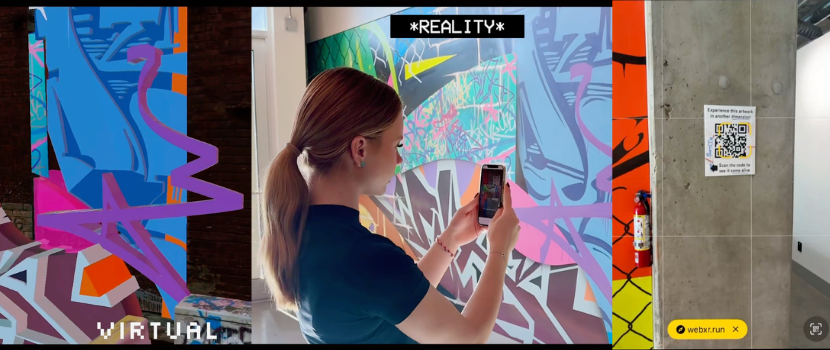
Jacobson’s philosophy—that spaces can be activated through technology and design—informs the work he does in Learning Technologies every day. At Sask Polytech, he works with faculty to develop immersive educational tools with the goal of helping students engage with what they are learning and understand through simulated, real-world application.
“What I do, both in my mural work and in the learning tools I build at Sask Polytech, is about making an idea land visually for someone who may not read a paragraph about it,” says Jacobson. “On a wall that's someone walking past. In a course it's a student trying to understand something at 11 p.m.”
In this way, Jacobson helps translate ideas by creating another layer of information that is more experiential. Ultimately, this can make an idea more accessible.
Jacobson has taken his years of experience with digital overlay and XR work and found a connection between seeing, experiencing and learning that translates to more formal learning in higher education. “Instructors have subject knowledge they know inside out,” he says, “but that can be tricky to show a student.” With Jacobson’s expertise, they can collaborate to build a model in Sask Polytech’s online learning environment so students can rotate it and look at it from different angles instead of reading a flat diagram.
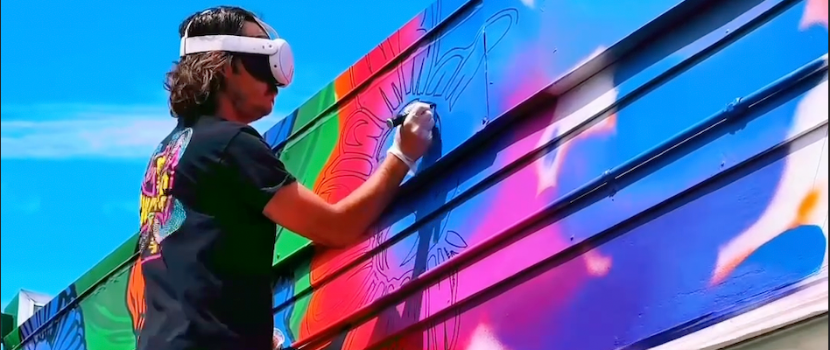
“I've been layering augmented reality onto murals for a few years and that same pipeline is what makes simulation-style learning objects possible, letting a student walk around something or see how a piece of equipment behaves without needing the physical lab,” he says. “The public art is where I work out the technique. The courses are where it gets a job.”
“I like innovating,” Jacobson says. “Our team in Learning Technologies has been working in this sphere of immersive augmented reality and we’ve been coming up with some inventive solutions, pushing the needle on what’s possible. We’ve created a carpentry store, for example, with all the tools rendered in 3D that a carpentry student might encounter.”
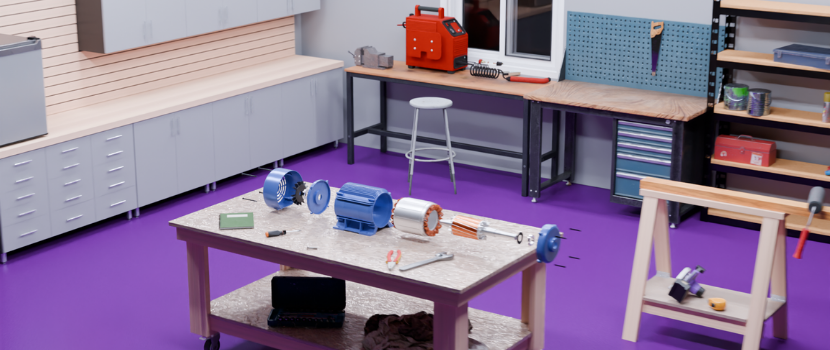
Working with Sask Polytech’s Centre for Continuing Education, Jacobson developed an augmented reality conduit bending course using Microsoft HoloLens. The high-tech outcome allows students in remote communities to learn the skill, and it gives instructors the ability to view videos of them, then connect directly through the technology.
“It’s exciting to take what we learn in one situation and apply it to another problem,” says Jacobson. “I’ve learned a lot about areas I had no idea about—x-ray machines, for example.”
Collaborating with the School of Health Sciences, Jacobson created an immersive, 1:1 replica of an x-ray laboratory, which allows students to learn through experience outside of lab time.
“My work at Sask Polyech is grounding,” Jacobson says. “It brings me back to digital work, offering a different perspective from my work as a mural artist. The work I do in both spaces complement each other. Sometimes the things I’m developing and learning when making a 3D model or an AR or VR experience overlaps and can be used in both avenues.”
Jacobson’s skills as a trainer also span his work spheres. In a recent Michif-centered mural project he facilitated through the Creative Action program in Saskatoon, guided by Michif Knowledge Keeper Auntie Faye Maurice, grade eight students drove the design. “I was there to help them see it through, which is much the same posture I take with instructors,” says Jacobson.

Though outside, creative work keeps him busy, Jacobson has no desire to freelance full time. “It’s nice to work for an employer supportive of my passion,” he says. “All of this work I do feels symbiotic. At Sask Polytech we’re allowed to explore and I value that.”
Visit Learning Technologies to learn more about the work Jacobson and his colleagues do at Sask Polytech. To learn more his creative projects beyond Sask Polytech, visit jjacobsondesign.ca.
